REVIEW · ROME
Rome Palatine Hill, Roman Forum, Colosseum Panoramic Views Tour
Book on Viator →Operated by Rome Colosseum Tours | Official Guided Tours · Bookable on Viator
Three hours can still feel endless in Rome.
This tour is interesting because it mixes Forum-focused time with viewpoint stops where the ruins actually look like a city again, not just scattered stone. I especially liked the panoramic photo angles from Capitoline/Palatine height, plus the way the route keeps you moving with a licensed Blue Badge guide using radio/headsets, so you don’t lose the story while you walk. In the reviews, guides such as Maria and Francesca are singled out for being thorough and genuinely passionate about what you’re seeing.
One possible drawback to plan for: Colosseum admission isn’t included, and the Roman Forum area has strict ID and security rules. If you’re hoping for lots of indoor Colosseum time, you’ll need to handle that ticket decision before the day gets busy.
In This Review
- Key points worth your attention
- Why This Palatine Hill and Roman Forum Route Feels Smarter Than a Full-Day Sprint
- Piazza del Campidoglio: Michelangelo’s Cordonata and the First Big View
- Trajan’s Forum and Trajan’s Column: Reading Two Campaigns in Stone
- Foro di Traiano
- Colonna Traiana
- The Roman Forum in Plain English: Temples, Courts, Markets, and Power Plays
- Palatine Hill: Where Augustus Built, and Where Rome’s Elite Once Stayed
- Arch of Constantine: A Victory Monument Built With Borrowed Stone
- Colosseum Panoramic Views: What You Get Outside, and What You Might Want Inside
- Price and Value: What You’re Paying For (and What You’re Not)
- Timing, Group Size, and Why the Meeting Point Matters
- Security and ID Rules: Don’t Treat These as Optional Paperwork
- Who This Tour Suits Best (and Who Might Prefer Something Different)
- Should You Book This Rome Palatine Hill, Roman Forum, Colosseum Panoramic Views Tour?
- FAQ
- How long is the tour?
- What language is the tour offered in?
- What is the price per person?
- Which sites have admission included?
- Is Colosseum admission included?
- Where do I meet the tour, and where does it end?
- Do I need an ID card or passport for entry?
- How many people are in the group?
- Does the tour provide radio/headsets?
- What cancellation options are available?
Key points worth your attention
- Forum-first strategy that saves you from spending your whole time stuck in Colosseum lines
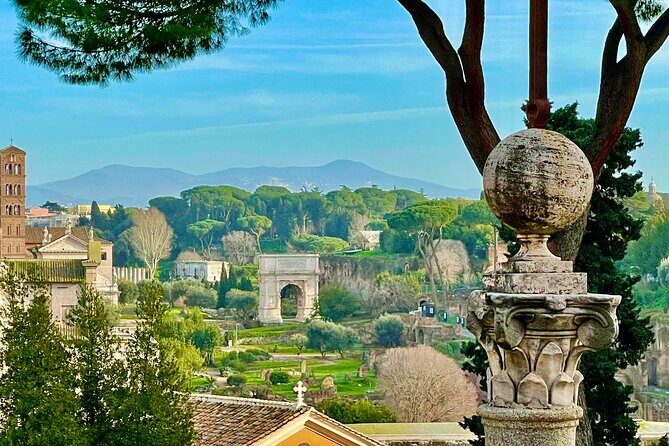
- Capitoline and Palatine viewpoints for photos that show how the ancient city was laid out
- Trajan’s Forum + Trajan’s Column explained as propaganda you can read in stone
- Roman Forum highlights without getting lost in the weeds of every temple ruin
- Smaller group size (max 24) and radio/headsets for clear, comfortable listening
- Tight but realistic timing (about 3 hours) with a route that works even when Rome feels chaotic
Why This Palatine Hill and Roman Forum Route Feels Smarter Than a Full-Day Sprint
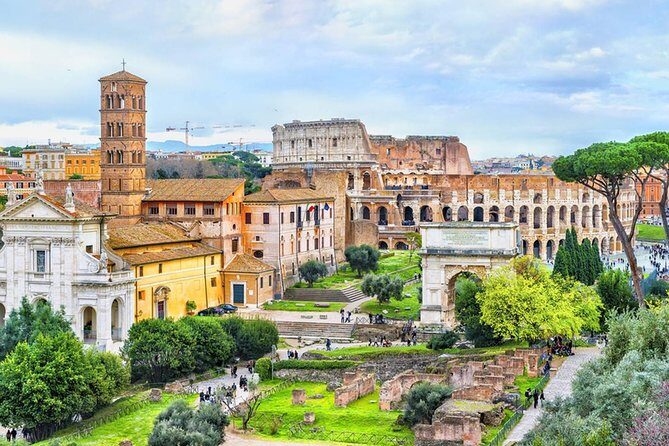
Rome has a funny way of making you feel like you have to choose between two things: either you do the famous sites fast, or you do them slowly and lose the day. This tour aims at a middle track. You get the big hitters—Roman Forum and Palatine Hill—while also getting a few strategic heights where the ruins snap into context.
The value pitch is simple: guided time on the places that are easiest to misunderstand on your own. A good guide turns “I see columns and broken walls” into “Oh, this is where laws were argued, crowds gathered, and emperors flexed power.” In the reviews, the standout theme is that the guiding is informative and thorough, not just a rapid recitation of dates.
Also, the format helps. With radio/headsets and a licensed local guide, you can keep up even if the group slows for photos or for a security bottleneck. That matters in Rome, where the walking is short but the stopping is constant.
Other Roman Forum tours we've reviewed
Piazza del Campidoglio: Michelangelo’s Cordonata and the First Big View
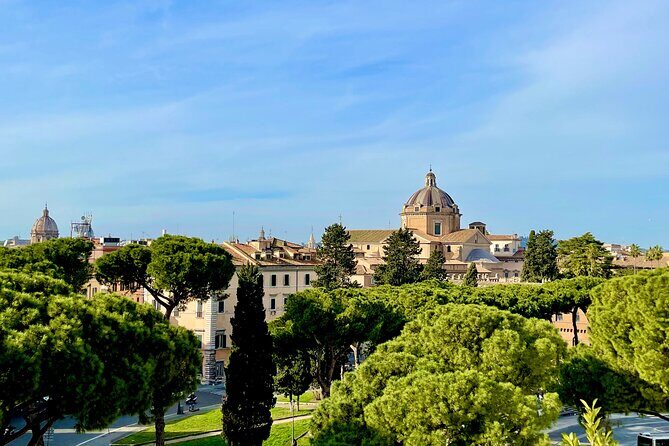
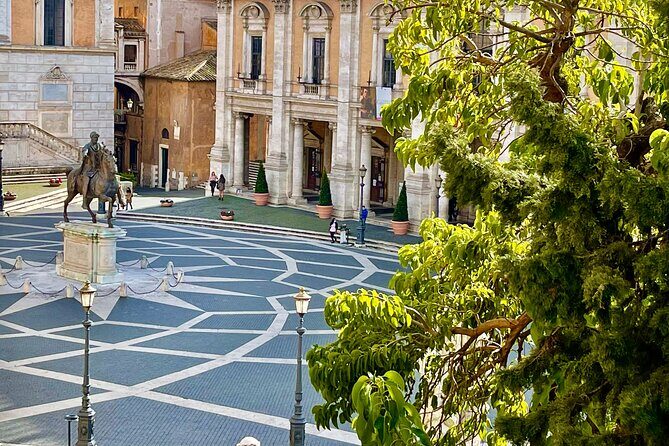
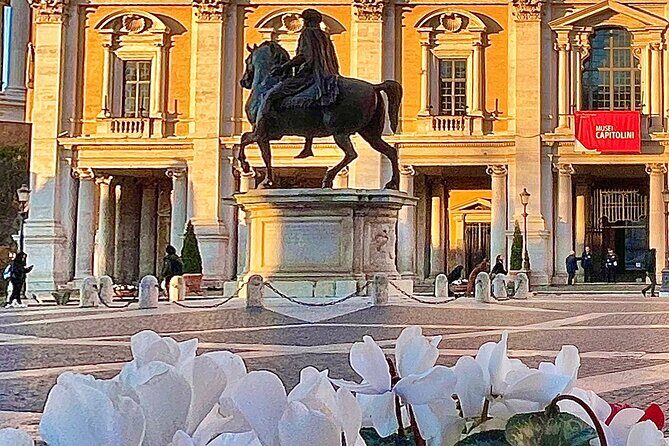
You start at Piazza del Campidoglio, one of those places where you can see the ancient city’s geometry without needing a map app. This square was shaped through a uniform project led by Michelangelo’s vision, on ground that had once housed an ancient village and was used to dedicate temples to Roman deities.
Here’s what makes this stop more than just a scenic breather. In 1536, when Pope Paul III helped transform the hill area (including commissioning Michelangelo during Charles V’s visit), Michelangelo designed a clear layout that guides your eye. The equestrian statue of Marcus Aurelius sits at the center on an elegant podium (placed in 1537). And the famous staircase, the Cordonata, uses giant steps so you can climb up with an actual sense of progression—like the square was designed as a stage.
Even if you’re not into Renaissance architecture, this is useful for your Roman ruin day. From here, you’ll be better at understanding what’s lower in the valleys and what sits on which hill.
Practical note: the stop is listed as about 20 minutes, so treat it as your warm-up view. If you need a snack, this isn’t the time; the tour is built for movement.
Trajan’s Forum and Trajan’s Column: Reading Two Campaigns in Stone
Then the tour moves into the meat of imperial Rome: Trajan’s Forum and Trajan’s Column. These are the kinds of monuments where a guide really changes the experience. Without context, you might just see an impressive structure. With it, you start seeing the message: war booty turned into public power.
Foro di Traiano
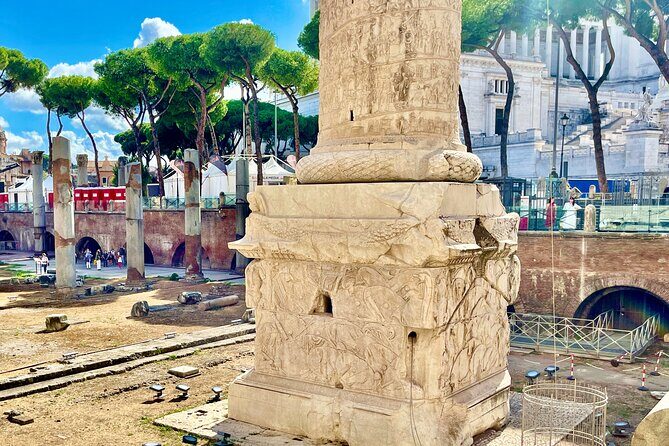
Trajan’s Forum was built by cutting through slopes around Quirinale and Campidoglio, then connecting them with a saddle-like section. Excavation works were probably started under Domitian in parallel with the Forum of Nerva. The project got interrupted after Domitian’s death in 96 AD, after a conspiracy. Trajan took over and financed the project using booty from the Dacian conquest—two military campaigns dated 101–102 and 105–106 AD. The architect was Apollodorus of Damascus, described as a military engineer who had accompanied Trajan.
What I like about guiding here is that you learn to picture why the location and design mattered. This wasn’t just a “pretty forum.” It was an engineered statement built into the city.
Entry here is listed as included.
Colonna Traiana
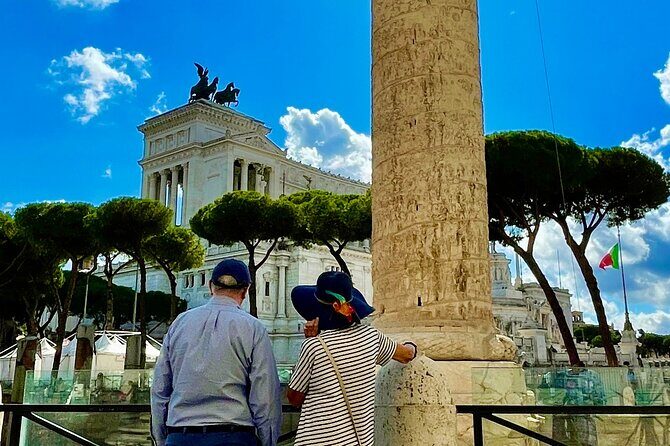
Next comes Trajan’s Column, and the explanation is one of the biggest reasons people enjoy this tour. The column’s reliefs tell the two Dacian campaigns in images tied to Trajan’s reign (98–117 AD). The column sits in the courtyard area defined by the monumental entrance to the Forum, the Basilica Ulpia, and the two libraries.
You get concrete details that make the monument feel physical, not abstract:
- The base includes bas-reliefs depicting stacks of weapons.
- The shaft is about 100 Roman feet high (roughly 30 meters).
- It’s made from 17 colossal rocks of white Carrara marble, nearly 4 meters in diameter.
- Inside is a spiral staircase of 185 steps.
- The frieze wraps around in a scroll-like rhythm totaling about 200 meters, with around 2,500 figures.
If you like storytelling, this is where the guide earns it. You’ll likely understand the reliefs in a way that makes your photos more than just “look, a column.” You’ll know what you’re photographing.
Entry here is also listed as included.
Other Palatine Hill tours we've reviewed
The Roman Forum in Plain English: Temples, Courts, Markets, and Power Plays
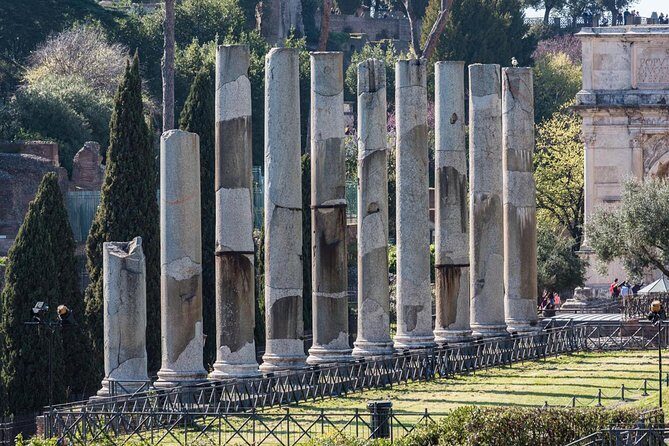
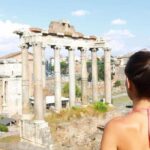
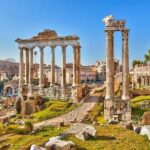
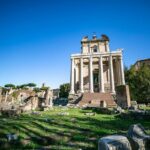
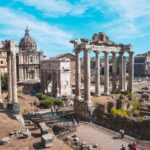
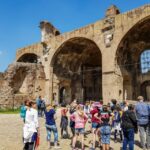
The Roman Forum stop is the heart of the whole experience. The Forum isn’t just one site; it’s a whole civic world on low ground between the Palatine and Capitoline hills.
Here’s the big shift your guide helps you notice: in republican times, the Forum was where people met to argue, judge, trade, and even watch gladiator combat. Under the empire, it became the stage for religious and secular ceremonies, with major temples and monuments lining the area.
What you’ll see (in whole or part) includes:
- Temple of Castor and Pollux
- Temple of the Deified Caesar
- Mamertine Prison
- Curia (senate house)
- Temple of Saturn
- Temple of Vesta
- Temple of Romulus
- Arch of Titus
- Arch of Septimius Severus
- Cloaca Maxima
I like how this stop trains your eyes. Once you know the categories—politics, worship, punishment, spectacle—it stops feeling like a random pile of fragments.
The itinerary gives it about 45 minutes, which is tight enough to keep things moving but long enough to absorb several key structures. Entry is listed as included.
Important to know before you go: Roman Forum security is strict. Bottles and glasses containers, alcoholic beverages, aerosols, and backpacks/bulky luggage are forbidden. Even selfie sticks are listed as not allowed. Medium and small backpacks may be allowed but must be checked and inspected. You’ll get screened for security reasons, so wear something simple.
Palatine Hill: Where Augustus Built, and Where Rome’s Elite Once Stayed
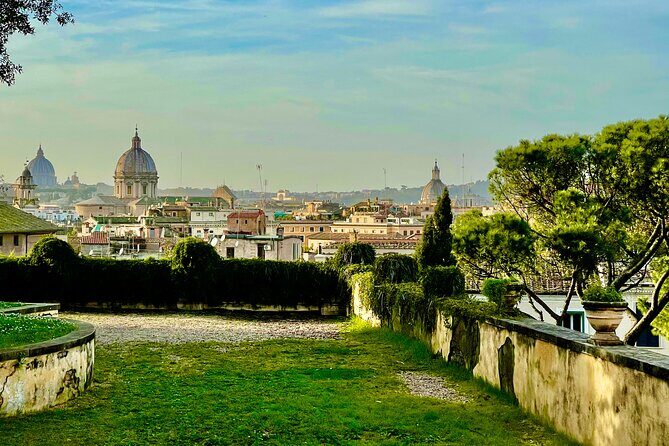
After Trajan’s monuments and the Forum, Palatine Hill feels like a shift back to everyday scale. It’s still museum-like, but more open, more “walkable,” and easier to sense as a neighborhood rather than just a ceremonial stage.
Palatine Hill is described as the center of Rome’s Seven Hills and one of the most ancient parts of the city, called the first nucleus of the Roman Empire. Today it’s mainly a large open-air museum, while the Palatine Museum houses finds from excavations here and from other ancient Italian sites.
The site matters because it’s where imperial palaces began with Augustus. Before the emperors, the hill was mostly home to the rich, which means you’re standing on power and privilege—just in different eras.
A few details that help you visualize the hill:
- It had two summits separated by a depression: the higher Palatium and the other Germalus (or Cermalus).
- Perimeter size references are given in acreage terms across catalogues, which underscores how much territory this “hill” covers.
This stop is listed as about 30 minutes, with entry included. If you’re the kind of person who likes to pause and look, you might want to save a bit of energy here for a longer view moment, since it’s one of the best places to connect what you learned in the Forum to who lived nearby.
Arch of Constantine: A Victory Monument Built With Borrowed Stone
The Arch of Constantine adds a different flavor because it sits right between the Colosseum and Palatine Hill. It spans the Via Triumphalis, the route victorious military leaders used in triumphal processions to enter the city.
This arch was commissioned by the Roman Senate to commemorate Constantine’s victory over Maxentius at the Battle of Milvian Bridge in AD 312. It was dedicated in 315 and described as the largest Roman triumphal arch, with dimensions roughly:
- 21 meters high
- 25.9 meters wide
- 7.4 meters deep
It has three bays, with the central bay taller than the two side bays. Construction is listed as brick-faced concrete riveted in marble.
The interesting twist: even though it’s dedicated to Constantine, much of the sculptural decoration uses reliefs and statues removed from earlier triumphal monuments dedicated to Trajan, Hadrian, and Marcus Aurelius. That means you’re seeing reused Roman messaging—old power props remixed into a new reign.
This is a short stop (about 10 minutes), but it works because it gives you a visual anchor. You can look from here toward the Colosseum area and instantly understand the sweep of the route.
Colosseum Panoramic Views: What You Get Outside, and What You Might Want Inside
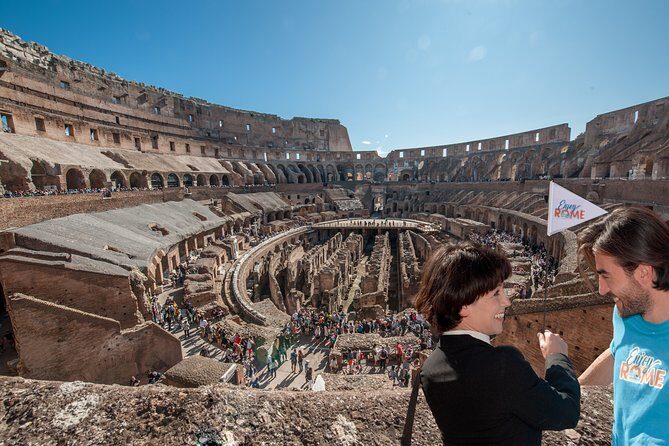
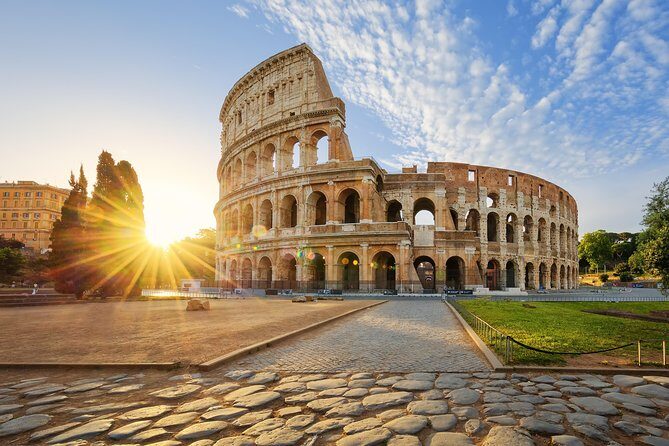
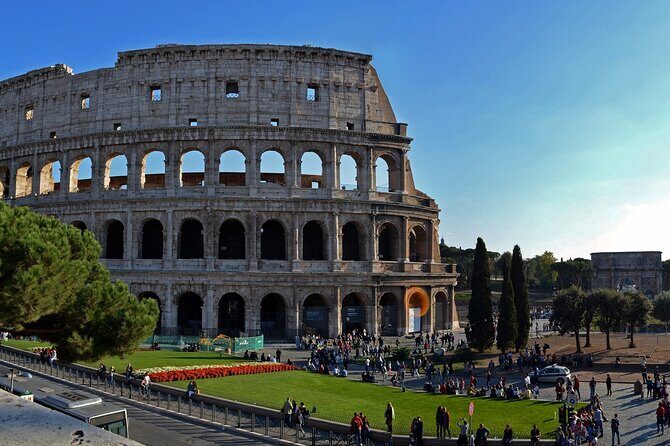
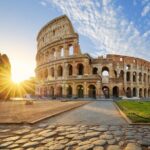
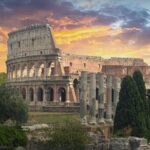
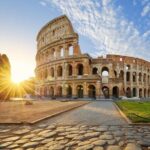
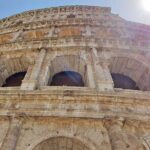
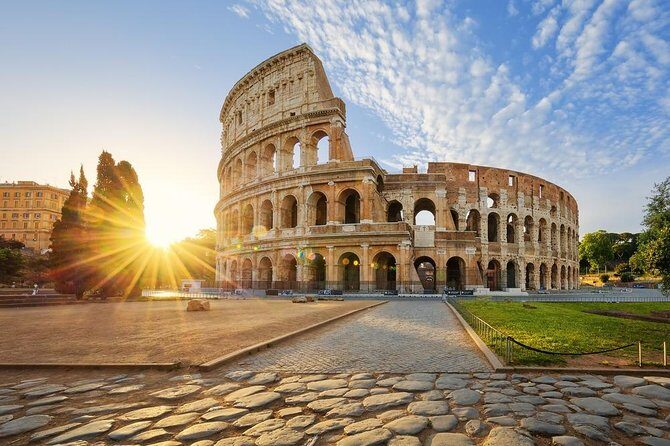
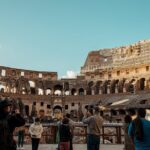
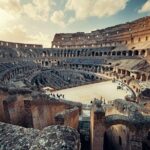
The tour finishes at the Colosseum area with an exterior-focused approach. The Colosseum stop includes orientation and storytelling, not just a quick glance.
Here’s what the tour description highlights about the Colosseum:
- Your guide will show you the best-preserved part and explain details about gladiator combat and animal fights.
- There’s also a mention of sea battles and the atmosphere of the crowd.
- It also references the idea of going to the 2nd tier for the best views inside and out.
But the key practical point is right in the tour details: Colosseum admission tickets are not included, and the service includes an exterior tour of the Colosseum. So if you plan to go inside, you’ll want to sort out your ticket and expectations ahead of time.
Why this matters for value: a guided exterior stop still pays off if you want context and viewpoint positioning. You’ll understand the building’s layout and what you’re looking at. You just won’t have the ticket included price.
Also, the Colosseum’s big-world credentials are noted:
- UNESCO World Heritage listing in 1990 for the historical center of Rome
- Included among the New Seven Wonders of the World in 2007
That background isn’t meant to be a flex; it’s useful because it explains why you’ll deal with crowds and why timing matters.
Price and Value: What You’re Paying For (and What You’re Not)
At $459.52 per person, this tour is not a budget add-on. The value is in three things you do get:
- Guided interpretation of multiple major monuments in a tight time window (about 3 hours).
- Radio/headsets so you can actually hear the guide on the move.
- Entry is included for key sites: Trajan Forum, Roman Forum, Palatine Hill, and the Imperial Forum area.
What you don’t get in the price:
- Colosseum admission tickets (you’ll need to buy separately if you want entry).
So the best way to judge value is to ask yourself two questions:
- If I was planning to visit Trajan Forum, Roman Forum, and Palatine Hill anyway, is having them stitched together by a guide worth paying more than going solo?
- If I also want Colosseum interior time, am I willing to buy that ticket separately?
If your answer is yes to both, this tour can feel like a smart structure for a “big Rome day” without drowning in the worst of the chaos.
Timing, Group Size, and Why the Meeting Point Matters
This tour runs about 3 hours and caps at 24 travelers, which is big enough to meet the crowds of the area but small enough for a guide to keep an eye on the group.
You meet at Piazza del Campidoglio (Campidoglio square), and the tour ends at Piazza del Colosseo.
One detail that can trip people up: you must arrive 20 minutes prior to departure. And the tour operator notes that the management doesn’t distribute individual tickets; there’s a group ticket for the entire group, so if you miss the tour start, you won’t receive tickets for late entry.
I treat that as a reminder to build in breathing room. In Rome, “just a few minutes late” can turn into “now you’re outside the plan.”
Security and ID Rules: Don’t Treat These as Optional Paperwork
Rome’s ancient sites don’t do “relaxed security.” You’ll need to plan for ID and screening.
Two important requirements are spelled out:
- At booking, you must provide your full name, and you’re asked to bring a valid ID card.
- A valid passport or ID document that matches the name provided at booking is required for successful entry to the Colosseum and Roman Forum.
Failure to provide a valid ID can mean denied entry to the Trajan Forum and the Roman Forum.
Security screening also includes rules about what you bring. Forbidden items list includes bottles and glasses containers, alcoholic beverages and aerosols, backpacks/camping/bulky bags, knives, and selfie sticks. You’ll see X-ray screening, and you’re asked to place items (including a mobile phone) in the tray to be included in the X-ray.
If you like traveling light, this is your moment to pack smart: small bag, no extras you won’t use, and ID ready.
Who This Tour Suits Best (and Who Might Prefer Something Different)
This is a strong fit if you:
- Want guided context at the Roman Forum and Palatine Hill, not just a self-guided wander
- Care about viewpoints and photo angles from higher ground
- Like learning the “why” behind monuments (Trajan’s Forum, Trajan’s Column, the re-used stones on the Arch of Constantine)
- Prefer a small-group pace (up to 24) with radio/headsets for clarity
It may be less ideal if you:
- Only care about spending hours inside the Colosseum. Since Colosseum admission isn’t included and the stop is exterior-oriented, you may need extra time elsewhere for a full interior experience.
- Want a very long, unstructured museum-style day. This is a focused route with set stops and timing.
Should You Book This Rome Palatine Hill, Roman Forum, Colosseum Panoramic Views Tour?
If you want the best chance of understanding Rome’s imperial core in just a few hours, I’d lean yes. The combination of Forum time, Palatine Hill views, and the Trajan monuments is exactly the kind of route that rewards a good guide. The reviews also back that up, with guides like Maria and Francesca praised for being thorough and clear—plus a recurring note to be ready to take plenty of photos.
Just be honest with your priorities before booking. If you’re counting on Colosseum entry being included, it won’t be. Plan to buy that ticket separately if you want inside time, and keep your ID ready for the Forum security checks.
If you do that, you’ll end the day with photos that actually make sense—and ruins you can read like a story instead of staring at stone in silence.
FAQ
How long is the tour?
The tour is listed as approximately 3 hours.
What language is the tour offered in?
It is offered in English.
What is the price per person?
The price is $459.52 per person.
Which sites have admission included?
Admission is included for Trajan Forum, Roman Forum, and Palatine Hill (and the Imperial Forum area).
Is Colosseum admission included?
No. The Colosseum admission ticket is not included, and the service includes an exterior tour of the Colosseum.
Where do I meet the tour, and where does it end?
You start at Piazza del Campidoglio, 00186 Roma RM, Italy and end at Piazza del Colosseo, 00184 Roma RM, Italy.
Do I need an ID card or passport for entry?
Yes. You must present a valid passport or ID document that matches the name provided at booking for successful entry to the Colosseum and Roman Forum. A valid ID card is requested for entry into the Roman Forum area.
How many people are in the group?
The tour has a maximum of 24 travelers.
Does the tour provide radio/headsets?
Yes. Radio and headsets are included so you can hear your licensed guide clearly.
What cancellation options are available?
You can cancel for a full refund if you cancel up to 24 hours in advance of the experience’s start time. Free cancellation is listed.